How Often Should You Get an AC Tune-Up in Miami?
The national recommendation is once a year. In South Florida, where your system runs ten to twelve months annually, that baseline is the minimum — not the ideal. Here is what Miami-Dade homeowners actually need.
- Annual tune-up is the absolute minimum for Miami systems
- Twice-yearly service recommended for year-round operation
- Skipping maintenance costs more in repairs and efficiency loss
- $50 off your first tune-up with Rocket HVACR
Why Miami's Climate Changes the Maintenance Math
In Chicago or Denver, an air conditioner might run from June through September — roughly four months. In Miami-Dade, October through April barely counts as a break. Most residential systems in South Florida operate ten to twelve months per year, accumulating two to three times the runtime hours of systems in temperate climates.
That runtime difference is not just about wear. It means filters clog faster, coils collect more dust and microbial growth, drain lines develop algae and clogs more frequently, and refrigerant connections are exposed to more thermal cycling stress. The result: a system that goes without maintenance for twelve months in Miami has effectively experienced the equivalent of two to three years of service in a cooler climate.
The practical answer to how often you should get a tune-up: at minimum once a year before the heaviest cooling season, and ideally twice — once before summer and once before the brief fall reduction in demand. For systems over eight years old or homes with known air quality concerns, twice-yearly service is strongly recommended.
What a Proper AC Tune-Up Includes
The Inspection and Cleaning Tasks That Matter
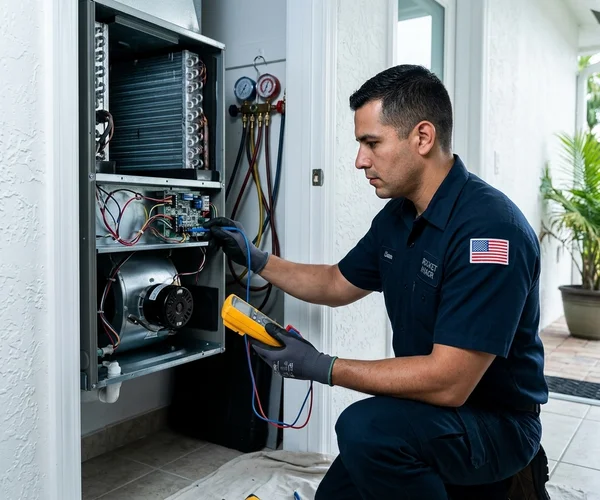
A proper tune-up is not just a filter change and a quick visual. At minimum it should include: cleaning or replacing the air filter, inspecting and cleaning the evaporator and condenser coils, checking refrigerant charge levels and inspecting for leaks, flushing the condensate drain line, testing electrical connections and capacitors, and verifying thermostat calibration.
In Miami's humid climate, coil cleaning and drain line flushing are especially critical. Algae and mold growth in the condensate system can cause drain pans to overflow, damaging ceilings and walls. A blocked drain line is one of the most common preventable service calls in South Florida — and one of the easiest to avoid with regular maintenance.
Additionally, a good tune-up includes a system performance check: measuring supply and return air temperatures, checking static pressure, and verifying airflow is consistent across all zones. These readings establish a baseline that makes it easier to spot developing problems before they become failures.
What Gets Missed When You Skip a Year
The compressor is the most expensive single component in your AC system, often costing $800 to $2,500 to replace in Miami. Compressors fail for many reasons, but running with low refrigerant, dirty coils, or an overworked capacitor significantly accelerates wear. All three of those conditions are caught and corrected in a standard tune-up.
Dirty coils force the compressor to work harder to achieve the same cooling output. Over time this increases operating temperatures, degrades lubricants, and shortens compressor life. A system that runs efficiently also draws less power — coil fouling alone can increase energy consumption by 5 to 15 percent, which shows up directly on your FPL bill.
Skipping a tune-up does not save the $99 to $200 service fee — it defers a small cost in exchange for a larger probability of a $500 to $3,000 repair, higher monthly electric bills, and a shortened system lifespan. In a climate where your system never truly rests, deferred maintenance compounds quickly.
Signs Your AC Is Overdue for Service
If any of these apply, schedule a tune-up before they escalate into repairs.
Higher Than Normal Electric Bills
An increase in your FPL bill without a change in usage habits is often the first sign that your system is losing efficiency due to dirty coils or low refrigerant.
Longer Run Times to Reach Temperature
If your system runs longer than it used to before the thermostat cycles off, it is working harder than necessary. Dirty filters or coils are common causes.
Water Near the Indoor Unit
Water pooling around the air handler is a sign of a clogged condensate drain line. In Miami's humidity, this can escalate quickly to water damage if not cleared.
Unusual Noises or Smells
Grinding, squealing, or musty odors indicate mechanical wear or microbial growth in the system — both of which are caught and addressed during a proper tune-up.
Uneven Cooling Across Rooms
Hot spots or rooms that take much longer to cool can indicate airflow issues, duct problems, or refrigerant imbalances — all items covered in a comprehensive tune-up.
More Than 12 Months Since Last Service
In Miami's climate, a 12-month gap between tune-ups is already stretching it. If you cannot remember the last service date, it is overdue.
What Miami Homeowners Say About Rocket HVACR Maintenance
AC Tune-Up Frequency Questions
Related Guides and Services
-
AC Tune-Up Service
Schedule a professional AC tune-up with Rocket HVACR. $50 off your first service, $0 service call fee with repair.
-
AC Maintenance Plans
Explore ongoing maintenance options to keep your Miami system running efficiently year-round.
-
Why Is My AC Not Blowing Cold Air?
If your AC is running but not cooling, this guide covers the most common causes and next steps.
-
Signs You Need AC Replacement
Know when maintenance is no longer enough and replacement becomes the smarter financial decision.
-
What Is SEER2?
Understand Florida's current efficiency requirements and which SEER2 rating makes sense for Miami-Dade.
Schedule Your Miami AC Tune-Up Today
Rocket HVACR provides comprehensive AC tune-ups for Miami-Dade homeowners. $50 off your first service. $0 service call fee with any repair. 24/7 availability with a 2-hour emergency response target.
Book a Tune-UpOr call us directly: (786) 716-1245